AARO "Puerto Rico Object" UAP Case Resolution Report
AAROReport landing2010sOfficial link verified
Summary
AI-assisted summary — not an official document and not authoritative. It condenses the machine-extracted text; the original is the only authoritative source. Generated by summary:claude-opus-4-8@v1; last reviewed 2026-05-28.
AARO's 'Puerto Rico Object' case resolution (20 March 2025). AARO assesses with high confidence the 2013 infrared objects showed no anomalous or transmedium behavior, and with moderate confidence they were a pair of sky lanterns.
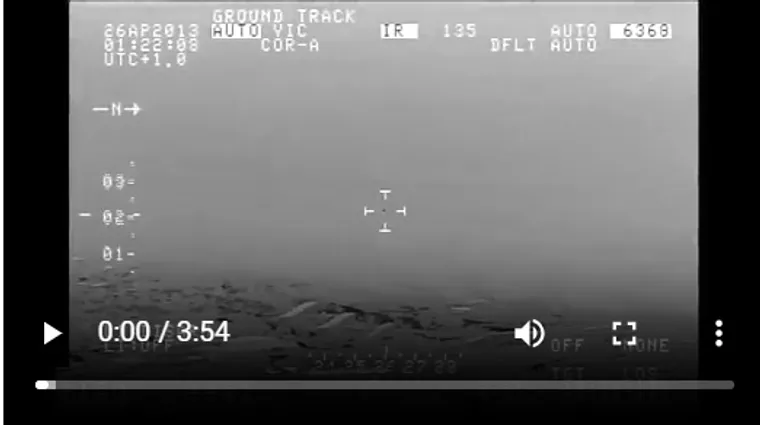
AARO's case resolution report for the "Puerto Rico Object," dated 20 March 2025. On 26 April 2013, an infrared sensor aboard a U.S. Customs and Border Protection aircraft near Aguadilla recorded two objects that appeared to move quickly and split apart. AARO assesses with high confidence that the objects did not exhibit anomalous speed or transmedium behavior, and with moderate confidence that they were a pair of sky lanterns. A Systems Toolkit reconstruction found the objects drifted at about 3.6 m/s (8 mph) in line with the wind at roughly 656 feet, their apparent speed explained by motion parallax, and showed they remained over land rather than entering the ocean as it appeared. AARO concludes the video depicts two objects traveling together rather than one splitting, and attributes their apparent disappearance to thermal crossover and degraded sensor conditions.
Common questions
What did AARO conclude about the Puerto Rico UAP objects recorded in 2013?
AARO assesses with high confidence the objects did not exhibit anomalous speed or transmedium behavior, and with moderate confidence they were a pair of sky lanterns drifting at about 8 mph at roughly 656 feet.
Why did the Puerto Rico objects appear to enter the ocean in the infrared video?
AARO's report states a Systems Toolkit reconstruction showed the objects remained over land rather than entering the ocean. Their apparent disappearance was attributed to thermal crossover and degraded sensor conditions.
What was the source of the Puerto Rico UAP footage?
The report states the footage was recorded on 26 April 2013 by an infrared sensor aboard a U.S. Customs and Border Protection aircraft near Aguadilla.
Preservation copy (PDF) ⬇
· 785 KB · 7 pp A local preservation copy of this public-domain U.S.-government document. The official source above is authoritative.
Documents are linked to their official source pages, with a local preservation copy of the public-domain U.S.-government document where available; the official source is authoritative. Videos are linked, not hosted. Copyright and license notes are recorded per source.
All-domain Anomaly Resolution Office (AARO). "AARO "Puerto Rico Object" UAP Case Resolution Report". 2010s. Official source: https://www.aaro.mil/UAP-Cases/UAP-Case-Resolution-Reports/. Cataloged by the independent UAP Records Archive (not an official or government source): https://uap-archive.org/uap/records/aaro-puerto-rico/.
@misc{uaprecords_aaro-puerto-rico,
title = {AARO "Puerto Rico Object" UAP Case Resolution Report},
author = {All-domain Anomaly Resolution Office (AARO)},
year = {2010s},
howpublished = {Official source: https://www.aaro.mil/UAP-Cases/UAP-Case-Resolution-Reports/},
note = {Cataloged by the independent UAP Records Archive — not an official or government source},
url = {https://uap-archive.org/uap/records/aaro-puerto-rico/}
}
Embed this record
Copy this HTML to embed the record card with attribution on your site.

<figure style="max-width:600px;margin:0;">
<a href="https://uap-archive.org/uap/records/aaro-puerto-rico/"><img src="https://uap-archive.org/og/records/aaro-puerto-rico.png" alt="AARO "Puerto Rico Object" UAP Case Resolution Report — UAP Records Archive" width="600" style="width:100%;height:auto;border:0;" loading="lazy"></a>
<figcaption style="font-size:13px;line-height:1.5;">All-domain Anomaly Resolution Office (AARO). "AARO "Puerto Rico Object" UAP Case Resolution Report". 2010s. Official source: https://www.aaro.mil/UAP-Cases/UAP-Case-Resolution-Reports/. Cataloged by the independent UAP Records Archive (not an official or government source): https://uap-archive.org/uap/records/aaro-puerto-rico/. <a href="https://uap-archive.org/uap/records/aaro-puerto-rico/">View record →</a></figcaption>
</figure>
AARO content is US Department of Defense work, generally public domain under 17 U.S.C. §105. DoD seal and identity usage is governed by 18 U.S.C. §701 and DoD Directive 5410.20 and is not used by this archive. License treatment for specific linked documents will be assessed before any indexed or monetized release.
Archivist note
AARO’s case resolution report for the “Puerto Rico Object,” dated 20 March 2025. The footage was recorded on 26 April 2013 by an infrared sensor aboard a U.S. Customs and Border Protection aircraft. AARO assesses with high confidence the objects did not exhibit anomalous behavior or transmedium capabilities, and with moderate confidence that they were a pair of sky lanterns (assessed altitude about 656 ft, speed about 8 mph).
The full English text below is machine-extracted from the linked PDF for reference; the original document is authoritative. This archive links the official source and an archive snapshot, and does not reproduce the DoD or AARO visual identity.
Full text (machine-extracted)
Machine-extracted text (tool: unpdf@1.6.2), reviewed by user:opus-review on 2026-05-28. Derived from the linked PDF; the original PDF (see official source / archive) is authoritative.
— p. 1 —
UNCLASSIFIED
1
UNCLASSIFIED
All-domain Anomaly Resolution Office (AARO)
U.S. Department of Defense
Case: “The Puerto Rico Object”
Case Resolution | 20 March 2025
Case Synopsis
Location: Puerto Rico
Date: April 26, 2013
Object Altitude (Reported): N/A
Object Altitude (Assessed): 656 ft
Object Speed (Reported): N/A
Object Speed (Assessed): 8 mph
Object Shape (Reported): N/A
Object Shape (Assessed): Indistinct
Reporter: Publicly available media, originally
recorded by U.S. Customs and Border
Protection.
Data Type: Infrared
Reported Behavior: Split or replicated;
transmedium behavior.
Assessed Behavior: The objects did not
demonstrate anomalous performance
characteristics.
Confidence: High confidence that the objects
did not demonstrate anomalous performance
characteristics. Moderate confidence that the
objects were a pair of sky lanterns.
25-P-0553
AARO Assessment and Case Status:
AARO assesses with high confidence1 that
the objects did not exhibit anomalous
behavior or transmedium capabilities.
AARO assesses with moderate confidence
that the objects were a pair of sky lanterns.
Case Overview
On April 26, 2013, an infrared (IR) sensor
onboard a U.S. Customs and Border
Protection (CBP) De Havilland Canada 8
aircraft flying above Rafael Hernandez
Airport near Aguadilla, Puerto Rico
captured thermal video footage of two
objects drifting at wind speed and direction.
The objects appeared to move at a high rate
of speed over the airport and surrounding
area before separating from one another.
The objects seemed to enter, exit, and
disappear into the Atlantic Ocean off
Puerto Rico's northwestern coast.
During the encounter, the CBP aircraft flew
in an arc around the Rafael Hernandez
Airport, gaining approximately 1,725 feet
in altitude before losing sensor contact with
the objects at 3,600 feet. The aircraft
entered a layer of scattered clouds as it
passed 3,000 feet in altitude. These clouds
partially obscured the sensor's view,
potentially affecting the objects’ sensor
return. The range between the aircraft and
the objects nearly tripled during the
encounter. These factors contribute to the
— p. 2 —
UNCLASSIFIED
2
UNCLASSIFIED
video’s diminishing quality over time. Figure 1 reconstructs the aircraft's flight path, sensor line-
of-sight to the ground, and position relative to the objects.
Figure 1: A reconstruction of the CBP aircraft's flight path is shown in green. Grey lines
indicate the sensor's line-of-sight to the ground from the aircraft. The yellow arrow shows the
objects’ assessed flight path.
Key Findings
AARO assesses with high confidence that:
• The objects did not exhibit anomalous speeds or other behavior exceeding known state-
of-the-art performance characteristics.
• The video depicts two objects traveling near each other rather than a single object
splitting into two.
— p. 3 —
UNCLASSIFIED
3
UNCLASSIFIED
Performance Characteristics
Object Speed: Systems Toolkit (STK) reconstruction determined the objects drifted at
approximately 3.6 meters per second (8 mph) in a straight line over land, consistent with the
recorded wind speed of 4.4 meters per second (9.8 mph) from the east/northeast.2
The objects’ apparent high speed is attributable to motion parallax. Motion parallax is an optical
effect that induces an observer to perceive that a stationary or slow-moving object is moving
much faster than its actual speed when viewed from a moving frame of reference. The more
quickly an observer moves relative to an observed object, the more pronounced this effect is. In
this case, the aircraft's flight speed, the sensor’s zoom, and the change in relative positions of the
aircraft and the objects influenced their perceived behavior and performance characteristics.
Object Flight Path: STK reconstruction integrated the aircraft's position with key sensor
parameters (e.g., elevation, azimuth, and slant angle) to model the objects’ flight path. The IR
sensor first detected the objects near the northeastern side of the airport at an altitude of
approximately 200 meters (656 feet). The objects drifted southwest at wind speed before the IR
sensor lost contact with them over the airport's central parking apron.
AARO reconstructed the sensor’s look angle by plotting the aircraft's position and the sensor's
view-to-ground projection onto a map (Figure 1). The reconstruction demonstrates that the
objects remained over land during the encounter.
Apparent Separation: AARO assesses with high confidence that the recording captures two
objects traveling near each other rather than a single object splitting or replicating. The objects
visibly separate multiple times within the first minute, suggesting that the video depicts two
objects the entire time. Separation occurs at approximately 00:29.56, 00:40.76, and 00:47.00
seconds (Figure 2). The IR sensor’s view of the objects changed from side-on to top-down as the
aircraft gained altitude. The sensor’s steeper viewing angle from a higher altitude likely made the
objects' separation more visually dramatic near the end of the video (Figure 3, Image C).
Apparent Transmedium Behavior: The STK reconstruction demonstrates that the objects did
not exhibit transmedium performance characteristics. “Transmedium” refers to objects that
transition between two or more domains, e.g., space, the atmosphere, or water, in ways not
attributable to known technologies. The objects remained over land throughout the video.
— p. 4 —
UNCLASSIFIED
4
UNCLASSIFIED
Figure 2: Stills images of object separation from within the first minute of the video.
Figure 3: These stills demonstrate how the changing view angle from the sensor to the objects
influenced their perceived behavior as the aircraft gained altitude. They appear to be one object
from a low angle and a low magnification, as shown in Image A at 00:05.14. The objects appear
distinct from one another from a steeper viewing angle and moderate magnification, as shown in
Image B at 00:33.41. Image C, at 02:37.44, shows the objects from a high angle and increased
magnification, clearly showing object separation from a more top-down perspective.
— p. 5 —
UNCLASSIFIED
5
UNCLASSIFIED
Observable Characteristics and Attribution
Size and Shape: AARO employed pixel analysis to estimate the objects’ sizes to be smaller than
one meter (three feet). Pixel analysis is a method of measuring an object’s size by comparing it
to an object of known dimensions. The objects’ shapes are indistinct.
Number of Objects: AARO assesses with high confidence that the video footage depicts two
objects traveling near each other rather than a single object splitting into two.
Attribution: AARO assesses with moderate confidence that the objects depicted in the video are
sky lanterns. AARO confirmed with local hospitality industry vendors that it is common
practice for hotels and resorts in the area to release sky lanterns during celebrations. The
objects’ size and thermal signature variability support this conclusion. Sky lanterns are typically
smaller than one meter in diameter and emit a flickering, weakening thermal signature as they
expend fuel, gradually losing distinctiveness against the background environment when viewed
through an IR sensor. However, the video’s poor quality reduces AARO’s confidence in
categorically identifying the objects.
IR signatures can appear to “vanish” when the thermal contrast between the object and
background becomes indistinguishable (Figure 4). The objects seem to disappear shortly after the
ocean appears in the background. The objects did not enter the water. Rather, the sensor could
not distinguish the objects from their environment due to a lack of thermal contrast between
them and the ocean.
Figure 4: IR signatures can lose distinctiveness when thermal contrast is low.
— p. 6 —
UNCLASSIFIED
6
UNCLASSIFIED
Data Quality and Methodology
AARO assesses that the sensor data associated with the encounter provides sufficiently detailed
information to resolve this case with high confidence. AARO’s assessment is informed by
reconstruction of the event using STK and Minimum Separation Vectors analysis.
Sensor Effects and Limitations
Thermal imaging can fail to differentiate a target object from the background when its thermal
signature is virtually identical to the surrounding environment to be distinct, known as thermal
crossover. When a sensor fails to discriminate a target from its environment, the object can seem
to vanish or intermittently disappear and reappear.3 Several factors affected the objects’ IR
signature, contributing to the perception that they entered the water or disappeared.
• Thermal Crossover:
This natural phenomenon reduces the effectiveness of thermal imaging systems in
detecting the contrast between an object and its environment during and after a rapid
temperature change, such as during sunrise and sunset. It can persist for up to two
hours.4
On April 26, 2013, sunset occurred at 7:48 p.m. local time. The IR sensor recorded
the event at 9:22 p.m. local time, within the two-hour window when thermal
crossover can influence IR sensor return.5
• Sensor Distance:
The aircraft’s distance from the objects nearly tripled during the observation period.
Sensor fidelity degrades with increasing distance to a target, especially for objects of
such small size.
• Cloud Cover:
Scattered clouds at 3,000 feet partially obscured the sensor's view. Cloud cover can
intermittently reduce an object’s thermal contrast, similar to the loss of detection that
can occur during thermal crossover.6 Intermittent sensor contact can make an object
appear to flicker or disappear and reappear on thermal imaging systems.
Alternative Hypotheses
Anomalous Phenomena: During specific frames, the objects seem to pass behind a utility pole,
indicating that they were at a much lower altitude and traveling much faster than would be
typical for objects of this size. AARO employed pixel analysis to investigate this alternative and
found that the objects did not pass behind the pole, ruling out anomalous performance
characteristics. Pixel analysis alone cannot determine the objects’ altitude or trajectory, though it
can set parameters for further analysis. Therefore, AARO used STK reconstruction to assess the
objects' flight behavior and performance characteristics. The STK reconstruction demonstrates
that the objects moved in a straight line at wind speed over land.
Marine Birds: An AARO partner assessed that the objects traveled between 35 and 130 mph at
an altitude between 300 and 900 feet. The partner suggested that the objects were a pair of
marine birds that descended to the surface of the Atlantic Ocean but noted that poor data quality
— p. 7 —
UNCLASSIFIED
7
UNCLASSIFIED
makes identification difficult. AARO considered this interpretation unlikely, as the STK
reconstruction demonstrates that the objects moved in a straight line at wind speed over land.
Further, birds viewed through an IR sensor at the distances involved in this encounter would
retain identifiable features, such as wings, or pulsate at the frequency of wing beats.
Mylar Balloons: An AARO partner assessed that the objects were a pair of mylar or “party”
balloons. The objects’ behavior is consistent with a pair of balloons drifting together and apart
while tied together. The partner also suggested that the objects’ fluctuating IR sensor return may
be attributable to the balloons’ surface reflecting light from the full moon through intermittent
cloud cover. AARO does not concur with this assessment, because it is unlikely that an IR sensor
could detect reflected moonlight.
1 Office of the Director of National Intelligence – Intelligence Community Directive 203: Analytic Standards
2 www.timeanddate.com
3 Journal article, Optics Express; Felton, M. et al.; 22 APR 2010; Measured comparison of the crossover period for mid- and
long-wave IR (MWIR and LWIR) polarimetric and conventional thermal imagery; Vol. 18, No.15.
4 Ibid.
5 www.sunrisesunset.com
6 Journal article, Optics Express; Felton, M. et al.; 22 APR 2010; Measured comparison of the crossover period for mid- and
long-wave IR (MWIR and LWIR) polarimetric and conventional thermal imagery; Vol. 18, No.15.
(U) AARO is not a member of the intelligence community. This AARO information report should
not be considered finished intelligence. It may contain references to finished intelligence reports
and/or information provided by AARO’s coordinating interagency partners to provide context, show
relevance, or substantiate AARO analytic perspectives.