— p. 1 — UNCLASSIFIED
1
UNCLASSIFIED
All-domain Anomaly Resolution Office (AARO)
U.S. Department of Defense
Case: “The Puerto Rico Object”
Case Resolution | 20 March 2025
Case Synopsis
Location: Puerto Rico
Date: April 26, 2013
Object Altitude (Reported): N/A
Object Altitude (Assessed): 656 ft
Object Speed (Reported): N/A
Object Speed (Assessed): 8 mph
Object Shape (Reported): N/A
Object Shape (Assessed): Indistinct
Reporter: Publicly available media, originally
recorded by U.S. Customs and Border
Protection.
Data Type: Infrared
Reported Behavior: Split or replicated;
transmedium behavior.
Assessed Behavior: The objects did not
demonstrate anomalous performance
characteristics.
Confidence: High confidence that the objects
did not demonstrate anomalous performance
characteristics. Moderate confidence that the
objects were a pair of sky lanterns.
25-P-0553
AARO Assessment and Case Status:
AARO assesses with high confidence1 that
the objects did not exhibit anomalous
behavior or transmedium capabilities.
AARO assesses with moderate confidence
that the objects were a pair of sky lanterns.
Case Overview
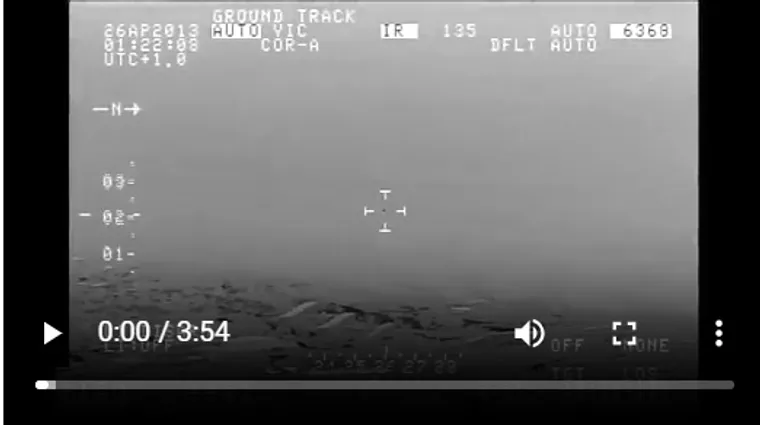
On April 26, 2013, an infrared (IR) sensor
onboard a U.S. Customs and Border
Protection (CBP) De Havilland Canada 8
aircraft flying above Rafael Hernandez
Airport near Aguadilla, Puerto Rico
captured thermal video footage of two
objects drifting at wind speed and direction.
The objects appeared to move at a high rate
of speed over the airport and surrounding
area before separating from one another.
The objects seemed to enter, exit, and
disappear into the Atlantic Ocean off
Puerto Rico's northwestern coast.
During the encounter, the CBP aircraft flew
in an arc around the Rafael Hernandez
Airport, gaining approximately 1,725 feet
in altitude before losing sensor contact with
the objects at 3,600 feet. The aircraft
entered a layer of scattered clouds as it
passed 3,000 feet in altitude. These clouds
partially obscured the sensor's view,
potentially affecting the objects’ sensor
return. The range between the aircraft and
the objects nearly tripled during the
encounter. These factors contribute to the
— 第 1 页 — 未分类
全域异常解决办公室(AARO)
美国国防部
案例:“波多黎各物体”
案例结案 | 2025年3月20日
案例概要
地点:波多黎各
日期:2013年4月26日
物体高度(报告):不适用
物体高度(评估):656英尺
物体速度(报告):不适用
物体速度(评估):8英里/小时
物体形状(报告):不适用
物体形状(评估):不清晰
报告者:公开可得的媒体,最初由美国海关与边境保护局录制。
数据类型:红外
报告的行为:分裂或复制;跨介质行为。
评估的行为:这些物体未表现出异常性能特征。
置信度:高置信度认为这些物体未表现出异常性能特征。中等置信度认为这些物体是一对孔明灯。
25-P-0553
AARO 评估与案例状态:
AARO 以高置信度¹评估这些物体未表现出异常行为或跨介质能力。AARO 以中等置信度评估这些物体是一对孔明灯。
案例概述
2013年4月26日,一具搭载于在波多黎各阿瓜迪亚附近拉斐尔·埃尔南德斯机场上空飞行的美国海关与边境保护局(CBP)德哈维兰加拿大 8 型飞机上的红外(IR)传感器,捕捉到两个以风速和风向飘移的物体的热成像视频。这些物体在机场及周边区域上空看似高速移动,随后彼此分离。这些物体似乎进入、离开并消失在波多黎各西北海岸外的大西洋中。在此次遭遇中,CBP 飞机绕拉斐尔·埃尔南德斯机场弧形飞行,爬升约1,725英尺,随后在3,600英尺处失去对物体的传感器接触。飞机在爬升经过3,000英尺时进入一层零散的云。这些云部分遮蔽了传感器视野,可能影响了物体的传感器回波。在此次遭遇中,飞机与物体之间的距离几乎增至三倍。这些因素导致了
— p. 2 — UNCLASSIFIED
2
UNCLASSIFIED
video’s diminishing quality over time. Figure 1 reconstructs the aircraft's flight path, sensor line-
of-sight to the ground, and position relative to the objects.
Figure 1: A reconstruction of the CBP aircraft's flight path is shown in green. Grey lines
indicate the sensor's line-of-sight to the ground from the aircraft. The yellow arrow shows the
objects’ assessed flight path.
Key Findings
AARO assesses with high confidence that:
• The objects did not exhibit anomalous speeds or other behavior exceeding known state-
of-the-art performance characteristics.
• The video depicts two objects traveling near each other rather than a single object
splitting into two.
— 第 2 页 — 视频质量随时间下降。图1重建了飞机的飞行路径、传感器对地面的视线,以及相对于物体的位置。
图1:CBP 飞机飞行路径的重建以绿色显示。灰色线表示传感器从飞机到地面的视线。黄色箭头显示物体的评估飞行路径。
主要发现
AARO 以高置信度评估:
• 这些物体未表现出超出已知最先进性能特征的异常速度或其他行为。
• 视频呈现的是两个彼此相邻飞行的物体,而非单个物体分裂为二。
— p. 3 — UNCLASSIFIED
3
UNCLASSIFIED
Performance Characteristics
Object Speed: Systems Toolkit (STK) reconstruction determined the objects drifted at
approximately 3.6 meters per second (8 mph) in a straight line over land, consistent with the
recorded wind speed of 4.4 meters per second (9.8 mph) from the east/northeast.2
The objects’ apparent high speed is attributable to motion parallax. Motion parallax is an optical
effect that induces an observer to perceive that a stationary or slow-moving object is moving
much faster than its actual speed when viewed from a moving frame of reference. The more
quickly an observer moves relative to an observed object, the more pronounced this effect is. In
this case, the aircraft's flight speed, the sensor’s zoom, and the change in relative positions of the
aircraft and the objects influenced their perceived behavior and performance characteristics.
Object Flight Path: STK reconstruction integrated the aircraft's position with key sensor
parameters (e.g., elevation, azimuth, and slant angle) to model the objects’ flight path. The IR
sensor first detected the objects near the northeastern side of the airport at an altitude of
approximately 200 meters (656 feet). The objects drifted southwest at wind speed before the IR
sensor lost contact with them over the airport's central parking apron.
AARO reconstructed the sensor’s look angle by plotting the aircraft's position and the sensor's
view-to-ground projection onto a map (Figure 1). The reconstruction demonstrates that the
objects remained over land during the encounter.
Apparent Separation: AARO assesses with high confidence that the recording captures two
objects traveling near each other rather than a single object splitting or replicating. The objects
visibly separate multiple times within the first minute, suggesting that the video depicts two
objects the entire time. Separation occurs at approximately 00:29.56, 00:40.76, and 00:47.00
seconds (Figure 2). The IR sensor’s view of the objects changed from side-on to top-down as the
aircraft gained altitude. The sensor’s steeper viewing angle from a higher altitude likely made the
objects' separation more visually dramatic near the end of the video (Figure 3, Image C).
Apparent Transmedium Behavior: The STK reconstruction demonstrates that the objects did
not exhibit transmedium performance characteristics. “Transmedium” refers to objects that
transition between two or more domains, e.g., space, the atmosphere, or water, in ways not
attributable to known technologies. The objects remained over land throughout the video.
— 第 3 页 — 性能特征
物体速度:Systems Toolkit(STK)重建确定这些物体以约3.6米/秒(8英里/小时)的速度在陆地上空沿直线飘移,这与记录到的来自东/东北方向4.4米/秒(9.8英里/小时)的风速相符。²
物体的表观高速可归因于运动视差。运动视差是一种光学效应,当从一个移动的参考系观察时,会使观察者觉得静止或缓慢移动的物体的移动速度远快于其实际速度。观察者相对于被观察物体移动得越快,这种效应越明显。在本案中,飞机的飞行速度、传感器的变焦,以及飞机与物体相对位置的变化,影响了它们被感知到的行为与性能特征。
物体飞行路径:STK 重建将飞机的位置与关键传感器参数(如俯仰、方位与斜角)整合起来,以建模物体的飞行路径。红外传感器最初在机场东北侧、约200米(656英尺)的高度探测到这些物体。这些物体以风速向西南飘移,随后红外传感器在机场中央停机坪上空失去与它们的接触。
AARO 通过将飞机位置及传感器对地视野投影绘制到地图上(图1),重建了传感器的观察角度。该重建表明,这些物体在此次遭遇中始终位于陆地上空。
表观分离:AARO 以高置信度评估该录像捕捉的是两个彼此相邻飞行的物体,而非单个物体分裂或复制。这些物体在第一分钟内多次明显分离,表明视频自始至终呈现的都是两个物体。分离发生在约00:29.56、00:40.76 和 00:47.00秒处(图2)。随着飞机爬升,红外传感器对物体的视角从侧视变为俯视。从更高高度产生的更陡观察角,很可能使物体的分离在视频末尾看起来更具戏剧性(图3,图像C)。
表观跨介质行为:STK 重建表明这些物体未表现出跨介质性能特征。“跨介质”指以无法归因于已知技术的方式在两个或多个域(例如太空、大气或水)之间转换的物体。这些物体在整段视频中始终位于陆地上空。
— p. 4 — UNCLASSIFIED
4
UNCLASSIFIED
Figure 2: Stills images of object separation from within the first minute of the video.
Figure 3: These stills demonstrate how the changing view angle from the sensor to the objects
influenced their perceived behavior as the aircraft gained altitude. They appear to be one object
from a low angle and a low magnification, as shown in Image A at 00:05.14. The objects appear
distinct from one another from a steeper viewing angle and moderate magnification, as shown in
Image B at 00:33.41. Image C, at 02:37.44, shows the objects from a high angle and increased
magnification, clearly showing object separation from a more top-down perspective.
— 第 4 页 — 图2:取自视频第一分钟内物体分离的静帧图像。
图3:这些静帧展示了随着飞机爬升,传感器到物体的观察角度变化如何影响其被感知到的行为。从低角度、低放大倍率看,它们显得像一个物体,如图像A(00:05.14)所示。从更陡的观察角度、中等放大倍率看,这些物体彼此显得分明,如图像B(00:33.41)所示。图像C(02:37.44)从高角度、更高放大倍率显示物体,从更接近俯视的视角清晰地显示出物体的分离。
— p. 5 — UNCLASSIFIED
5
UNCLASSIFIED
Observable Characteristics and Attribution
Size and Shape: AARO employed pixel analysis to estimate the objects’ sizes to be smaller than
one meter (three feet). Pixel analysis is a method of measuring an object’s size by comparing it
to an object of known dimensions. The objects’ shapes are indistinct.
Number of Objects: AARO assesses with high confidence that the video footage depicts two
objects traveling near each other rather than a single object splitting into two.
Attribution: AARO assesses with moderate confidence that the objects depicted in the video are
sky lanterns. AARO confirmed with local hospitality industry vendors that it is common
practice for hotels and resorts in the area to release sky lanterns during celebrations. The
objects’ size and thermal signature variability support this conclusion. Sky lanterns are typically
smaller than one meter in diameter and emit a flickering, weakening thermal signature as they
expend fuel, gradually losing distinctiveness against the background environment when viewed
through an IR sensor. However, the video’s poor quality reduces AARO’s confidence in
categorically identifying the objects.
IR signatures can appear to “vanish” when the thermal contrast between the object and
background becomes indistinguishable (Figure 4). The objects seem to disappear shortly after the
ocean appears in the background. The objects did not enter the water. Rather, the sensor could
not distinguish the objects from their environment due to a lack of thermal contrast between
them and the ocean.
Figure 4: IR signatures can lose distinctiveness when thermal contrast is low.
— 第 5 页 — 可观察特征与归因
尺寸与形状:AARO 采用像素分析估计这些物体的尺寸小于一米(三英尺)。像素分析是一种通过将物体与已知尺寸的物体进行比较来测量其大小的方法。这些物体的形状不清晰。
物体数量:AARO 以高置信度评估视频画面呈现的是两个彼此相邻飞行的物体,而非单个物体分裂为二。
归因:AARO 以中等置信度评估视频中所示的物体是孔明灯。AARO 向当地酒店业供应商确认,该地区的酒店和度假村在庆祝活动期间放飞孔明灯是常见做法。物体的尺寸与热信号的变动性支持这一结论。孔明灯通常直径小于一米,在耗尽燃料时发出闪烁、减弱的热信号,通过红外传感器观察时会逐渐相对背景环境失去其鲜明度。然而,视频的低质量降低了 AARO 对物体明确识别的置信度。
当物体与背景之间的热对比变得无法区分时,红外信号可能看似“消失”(图4)。这些物体在背景中出现海洋后不久似乎就消失了。这些物体并未进入水中。相反,由于物体与海洋之间缺乏热对比,传感器无法将物体与其环境区分开来。
图4:当热对比较低时,红外信号会失去鲜明度。
— p. 6 — UNCLASSIFIED
6
UNCLASSIFIED
Data Quality and Methodology
AARO assesses that the sensor data associated with the encounter provides sufficiently detailed
information to resolve this case with high confidence. AARO’s assessment is informed by
reconstruction of the event using STK and Minimum Separation Vectors analysis.
Sensor Effects and Limitations
Thermal imaging can fail to differentiate a target object from the background when its thermal
signature is virtually identical to the surrounding environment to be distinct, known as thermal
crossover. When a sensor fails to discriminate a target from its environment, the object can seem
to vanish or intermittently disappear and reappear.3 Several factors affected the objects’ IR
signature, contributing to the perception that they entered the water or disappeared.
• Thermal Crossover:
This natural phenomenon reduces the effectiveness of thermal imaging systems in
detecting the contrast between an object and its environment during and after a rapid
temperature change, such as during sunrise and sunset. It can persist for up to two
hours.4
On April 26, 2013, sunset occurred at 7:48 p.m. local time. The IR sensor recorded
the event at 9:22 p.m. local time, within the two-hour window when thermal
crossover can influence IR sensor return.5
• Sensor Distance:
The aircraft’s distance from the objects nearly tripled during the observation period.
Sensor fidelity degrades with increasing distance to a target, especially for objects of
such small size.
• Cloud Cover:
Scattered clouds at 3,000 feet partially obscured the sensor's view. Cloud cover can
intermittently reduce an object’s thermal contrast, similar to the loss of detection that
can occur during thermal crossover.6 Intermittent sensor contact can make an object
appear to flicker or disappear and reappear on thermal imaging systems.
Alternative Hypotheses
Anomalous Phenomena: During specific frames, the objects seem to pass behind a utility pole,
indicating that they were at a much lower altitude and traveling much faster than would be
typical for objects of this size. AARO employed pixel analysis to investigate this alternative and
found that the objects did not pass behind the pole, ruling out anomalous performance
characteristics. Pixel analysis alone cannot determine the objects’ altitude or trajectory, though it
can set parameters for further analysis. Therefore, AARO used STK reconstruction to assess the
objects' flight behavior and performance characteristics. The STK reconstruction demonstrates
that the objects moved in a straight line at wind speed over land.
Marine Birds: An AARO partner assessed that the objects traveled between 35 and 130 mph at
an altitude between 300 and 900 feet. The partner suggested that the objects were a pair of
marine birds that descended to the surface of the Atlantic Ocean but noted that poor data quality
— 第 6 页 — 数据质量与方法
AARO 评估与此次遭遇相关的传感器数据提供了足够详尽的信息,可以高置信度结案。AARO 的评估参考了使用 STK 与最小间隔向量分析对事件的重建。
传感器效应与局限
当目标物体的热信号与周围环境几乎相同、难以区分时,热成像可能无法将目标物体与背景区分开来,这被称为热交越。当传感器无法将目标与其环境区分时,物体可能看似消失,或间歇性地消失再重现。³ 多个因素影响了物体的红外信号,促成了它们进入水中或消失的感知。
• 热交越:
这一自然现象在快速温度变化(例如日出和日落)期间及之后,会降低热成像系统探测物体与其环境间对比的有效性。它可持续长达两小时。⁴
2013年4月26日,当地时间下午7:48日落。红外传感器在当地时间下午9:22记录此事件,处于热交越可影响红外传感器回波的两小时窗口内。⁵
• 传感器距离:
在观察期间,飞机与物体的距离几乎增至三倍。随着到目标距离的增加,传感器保真度会下降,对于如此小尺寸的物体尤其如此。
• 云层:
3,000英尺处的零散云部分遮蔽了传感器视野。云层可间歇性地降低物体的热对比,类似于热交越期间可能发生的探测丢失。⁶ 间歇性的传感器接触会使物体在热成像系统上看似闪烁或消失再重现。
替代假说
异常现象:在特定帧中,这些物体似乎从一根电线杆后方经过,表明它们处于低得多的高度、移动速度也远快于此类尺寸物体的典型情况。AARO 采用像素分析调查了这一替代解释,发现这些物体并未从电线杆后方经过,排除了异常性能特征。仅凭像素分析无法确定物体的高度或轨迹,尽管它可以为进一步分析设定参数。因此,AARO 使用 STK 重建来评估物体的飞行行为与性能特征。STK 重建表明这些物体以风速在陆地上空沿直线移动。
海鸟:一个 AARO 合作伙伴评估这些物体以35至130英里/小时的速度、在300至900英尺之间的高度行进。该合作伙伴提出这些物体是一对降至大西洋海面的海鸟,但指出数据质量差使识别变得困难。AARO 认为这一解释不太可能,因为 STK 重建表明这些物体以风速在陆地上空沿直线移动。
— p. 7 — UNCLASSIFIED
7
UNCLASSIFIED
makes identification difficult. AARO considered this interpretation unlikely, as the STK
reconstruction demonstrates that the objects moved in a straight line at wind speed over land.
Further, birds viewed through an IR sensor at the distances involved in this encounter would
retain identifiable features, such as wings, or pulsate at the frequency of wing beats.
Mylar Balloons: An AARO partner assessed that the objects were a pair of mylar or “party”
balloons. The objects’ behavior is consistent with a pair of balloons drifting together and apart
while tied together. The partner also suggested that the objects’ fluctuating IR sensor return may
be attributable to the balloons’ surface reflecting light from the full moon through intermittent
cloud cover. AARO does not concur with this assessment, because it is unlikely that an IR sensor
could detect reflected moonlight.
1 Office of the Director of National Intelligence – Intelligence Community Directive 203: Analytic Standards
2 www.timeanddate.com
3 Journal article, Optics Express; Felton, M. et al.; 22 APR 2010; Measured comparison of the crossover period for mid- and
long-wave IR (MWIR and LWIR) polarimetric and conventional thermal imagery; Vol. 18, No.15.
4 Ibid.
5 www.sunrisesunset.com
6 Journal article, Optics Express; Felton, M. et al.; 22 APR 2010; Measured comparison of the crossover period for mid- and
long-wave IR (MWIR and LWIR) polarimetric and conventional thermal imagery; Vol. 18, No.15.
(U) AARO is not a member of the intelligence community. This AARO information report should
not be considered finished intelligence. It may contain references to finished intelligence reports
and/or information provided by AARO’s coordinating interagency partners to provide context, show
relevance, or substantiate AARO analytic perspectives.
— 第 7 页 — 此外,在此次遭遇所涉距离下通过红外传感器观察的鸟类,会保留可识别的特征(如翅膀),或以扇翅频率脉动。
聚酯薄膜(Mylar)气球:一个 AARO 合作伙伴评估这些物体是一对聚酯薄膜或“派对”气球。物体的行为与一对被系在一起、时而聚拢时而分开飘移的气球相符。该合作伙伴还提出,物体起伏波动的红外传感器回波可能归因于气球表面通过间歇性云层反射满月的光。AARO 不认同这一评估,因为红外传感器不太可能探测到反射的月光。
¹ 国家情报总监办公室——情报界指令203:分析标准
² www.timeanddate.com
³ 期刊文章,《光学快报》(Optics Express);Felton, M. 等;2010年4月22日;中波与长波红外(MWIR 和 LWIR)偏振与常规热成像的交越周期实测对比;第18卷,第15期。
⁴ 同上。
⁵ www.sunrisesunset.com
⁶ 期刊文章,《光学快报》(Optics Express);Felton, M. 等;2010年4月22日;中波与长波红外(MWIR 和 LWIR)偏振与常规热成像的交越周期实测对比;第18卷,第15期。
AARO 不是情报界成员。本 AARO 信息报告不应被视为成品情报。它可能引用成品情报报告和/或 AARO 协调的跨机构合作伙伴提供的信息,以提供背景、显示相关性或佐证 AARO 的分析观点。